How to learn Spanish when you move to Tenerife: free resources and typical newcomer mistakes
Published on 29. November 2026 08:43 in Useful Tips
Free courses, language exchanges and online resources for learning Spanish in Tenerife, and the mistakes newcomers make most often.
Tenerife is an easy place to start a new life – and, at the same time, an easy place to never learn Spanish. In Costa Adeje or Los Cristianos you can live for months speaking only English or German. The problem shows up later: an appointment at the health centre, a call from the town hall, a meeting at your children's school. That is when the language stops being optional.
The good news is that the island has plenty of free or very affordable ways to learn. And most of the mistakes newcomers make can be avoided from the very first month.
Where to learn Spanish in Tenerife without spending much
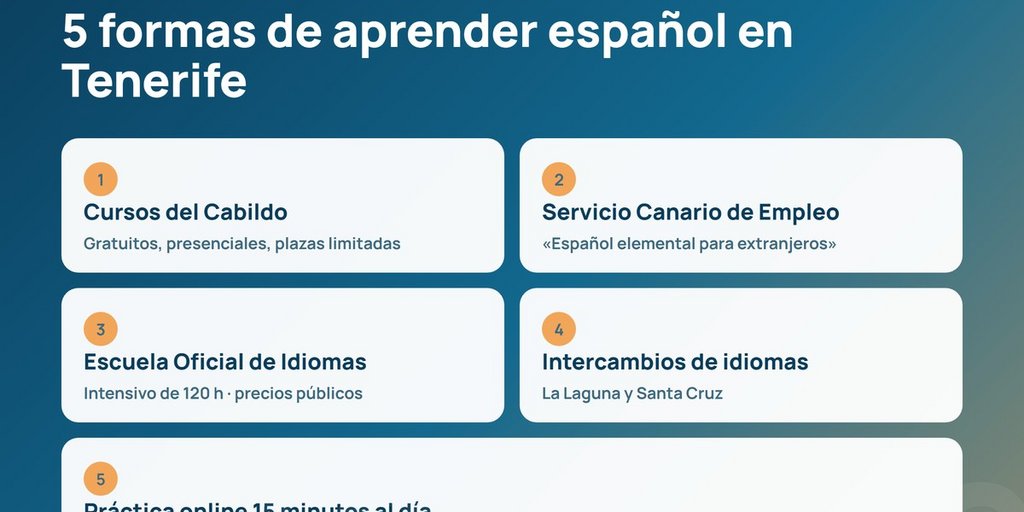
- Free courses by the Cabildo de Tenerife. The Cabildo's Volunteer Office runs free, in-person Spanish courses for foreigners, at beginner and basic level. They focus on real situations: introducing yourself, getting around the island, shopping, finding accommodation, going to the doctor or doing paperwork. Places are limited, so it is worth checking their website, Tenerife Isla Solidaria, for the next call for applications.
- Subsidised courses by the Servicio Canario de Empleo (SCE). Courses such as «Elementary Spanish for foreigners» are regularly offered, free of charge and publicly funded, in different municipalities around the island. They are aimed at both unemployed and employed people and are applied for through the SCE itself.
- Escuela Oficial de Idiomas in Santa Cruz de Tenerife. It is not free, but fees are public. It offers an intensive 120-hour Spanish course for foreigners that covers a full year's content in one term. You have to apply in spring (usually between March and April) and, if you already know some Spanish, take a placement test. Note: it starts at level A2, so it is not the best option for complete beginners.
- Language exchanges. In La Laguna, the university city, and in Santa Cruz, exchanges are organised regularly: half an hour in your language and half an hour in Spanish. They do not replace a course, but they are perfect for losing the fear of speaking.
- Online resources for daily practice. Between classes you need short, consistent practice: conjugating verbs, revising vocabulary, training your ear with numbers. There are free tools for almost every native language. For example, if you speak Russian, Edespa offers free interactive conjugation, vocabulary and phonetics exercises with audio, explained in Russian and with no registration required.
The Spanish of the Canary Islands: what the textbook does not teach you
Many newcomers are surprised when they hear the Spanish spoken on the street. Canarian Spanish has its own features, and knowing them saves a lot of confusion:
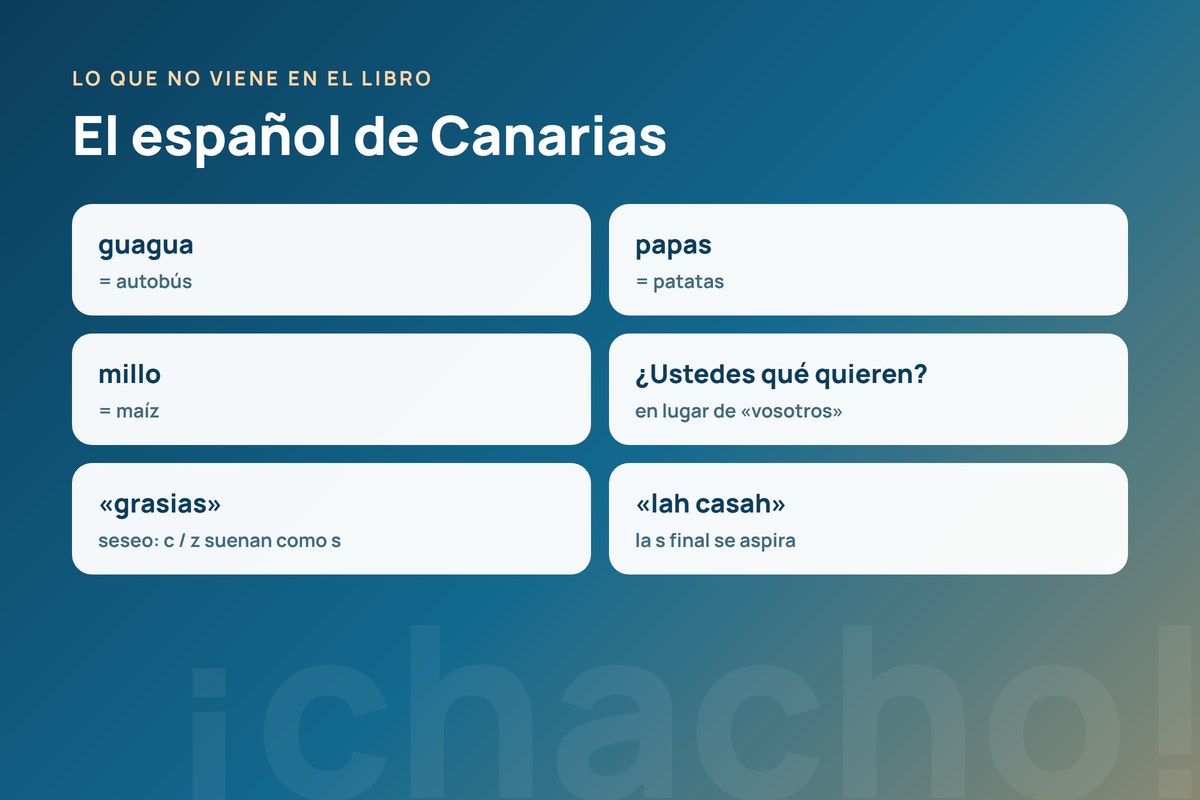
- «Ustedes» instead of «vosotros». In the Canaries, «vosotros» is barely used. A group of friends is addressed as «¿ustedes qué quieren?», as in Latin America.
- Seseo. The «z» and the «c» before «e» or «i» are pronounced like «s»: «gracias» sounds like «grasias».
- A soft final «s». It is often aspirated or nearly disappears: «lah casah» instead of «las casas».
- Local words. La guagua is the bus, las papas are the potatoes, el millo is the maize, and «¡chacho!» is the exclamation you will hear all the time, especially to express surprise.
If you study with a peninsular textbook, do not worry: people will understand you perfectly. But get your ear used to the local accent from the start, for example with Canarian radio or television.
Typical mistakes newcomers make
- Expecting the language to «come on its own». Living in Tenerife is not enough. Without regular study and practice, after a year many people still understand little more than «hola» and «gracias».
- Staying in the bubble. In tourist areas everything works in English: the supermarket, the bar, the estate agent. It is comfortable, but it slows you down. Deliberately choosing places where Spanish is spoken (the municipal market, the bus, the neighbourhood bar) speeds up progress a lot.
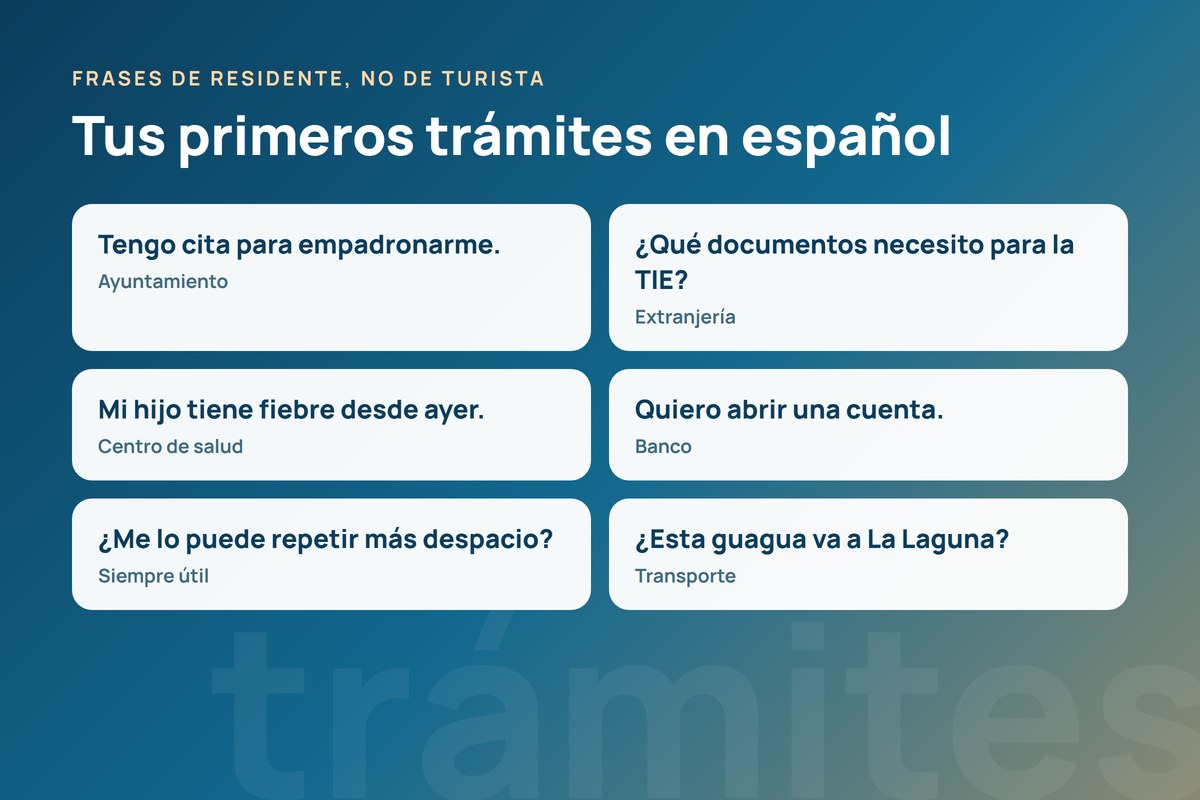
- Learning tourist phrases instead of resident phrases. «Where is the beach?» is of little use. What you really need is: «I have an appointment to register at the town hall», «What documents do I need for the TIE?», «My child has had a fever since yesterday». Start with the vocabulary of your paperwork and your daily life.
- Being afraid of making mistakes. Canarians are usually patient and appreciate the effort. A sentence with mistakes opens more doors than a perfect sentence you never say.
- Studying a lot one day and nothing the rest of the week. Consistency works better: 15 minutes a day achieve more than three hours on Sunday.
A simple plan for your first three months
- Month 1: sign up for a course (Cabildo, SCE or an academy) and learn the phrases for your paperwork: registering at the town hall, the health centre, the bank.
- Month 2: add 15 minutes of daily online practice and one language exchange a week.
- Month 3: do at least one full errand in Spanish (a phone call or an appointment) and dare to chat with a neighbour.
Learning Spanish in Tenerife is not just a question of grammar: it is the difference between living on the island and truly living in it. And taking the first step does not cost a thing.